Beareye · Cyber Threat Intelligence
Dark web monitoring: detect exposed data before it is exploited
By Steven Carrier Updated on
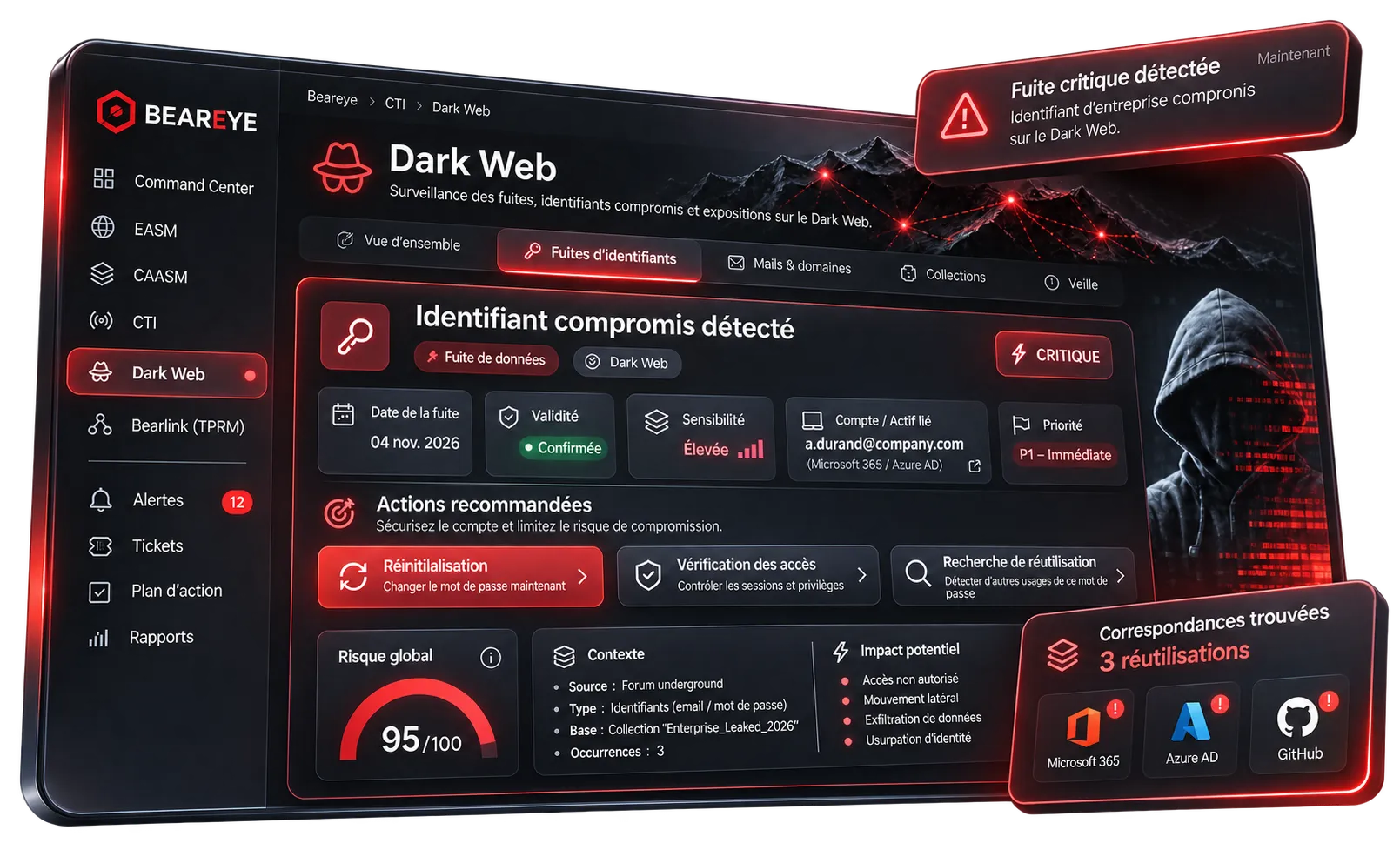
The dark web is the hidden part of the internet where stolen data is resold. Beareye monitors it for what concerns you: credentials, email addresses, documents and bank details exposed following a leak. Each finding is qualified, correlated with your exposure and with Beareye Cyber Threat Intelligence , and triggers an alert so you can act before an attacker exploits the data.
- Continuous detection
- Leak qualification
- Developed in France
A leak discovered too late
A reused password, a database compromised at a service provider, an employee who fell for a trap: your organisation’s credentials end up for sale without anyone knowing. Months can pass between the leak and the attack. Monitoring the dark web means regaining that head start.
What data does Beareye monitor on the dark web?
Beareye monitors compromised credentials and passwords, exposed email addresses, leaked internal documents, bank details and phone numbers associated with your organisation. Each type of data is handled according to its sensitivity.
-
Credentials and passwords
The access that opens your email, VPN and applications directly.
-
Email addresses
Exposed addresses, prime targets for phishing and fraud.
-
Internal documents
Contracts, plans or exports that reveal how you operate to an attacker.
-
Bank details
The data behind payment fraud and supplier impersonation.
-
Phone numbers
The entry points for voice and SMS phishing.
What does dark web monitoring cover, and what are its limits?
From a detected leak to useful action
-
Detect
Identify exposed data that concerns you.
-
Qualify
Date the leak, assess its validity and its sensitivity.
-
Correlate
Link the data to a real asset or account.
-
Alert
Trigger a prioritised alert and a response plan.
What should you do about a compromised credential?
When a credential is exposed, Beareye guides the response: resetting the password, checking access, looking for reuse elsewhere. The leak is escalated to the Command Center with its priority, so that remediation is tracked like any other vulnerability.
What share of organisations have credentials exposed on the dark web?
All 20 organisations monitored with Beareye had at least one business credential exposed, in a data leak or on the dark web. Of the credentials whose validity could be checked within an authorised framework, 8% were still usable when detected. A valid credential can be enough for initial access.
Aggregated, anonymised data from Beareye’s dark web monitoring: 20 organisations over two years, 20 out of 20 affected. The 8% rate covers only the credentials whose validity was checked.
Sources and references
- Regulation (EU) 2016/679 (GDPR), Article 33, EUR-Lex
- Notifying a personal data breach, CNIL, the French data protection authority (in French)
Sources consulted on . Report an error: contact+site@bearops.fr
Frequently asked questions
What is dark web monitoring?
It is the continuous search, across the hidden spaces of the internet, for an organisation’s data that has been exposed or put up for sale: credentials, email addresses, documents. The aim is to detect a leak before an attacker exploits it.
Does Beareye see the whole dark web?
No, and no tool can. Part of the dark web remains closed. Beareye prioritises the sources most used by attackers. Being honest about these limits is better than promising total coverage.
What should you do when a credential has leaked?
Beareye qualifies the leak, dates it and links it to a real account, then guides the response: reset, access checks, search for reuse. The leak is tracked in the Command Center until it is resolved.
Is dark web monitoring part of CTI?
Yes. It is a capability of the Beareye CTI module , alongside OSINT and the mapping of attack techniques. Detected leaks are correlated with the rest of the threat intelligence.
Must a leak detected on the dark web be notified to the CNIL?
It depends on the data involved. If personal data has leaked, the GDPR (Article 33) requires the breach to be notified to the CNIL, the French data protection authority, within 72 hours of becoming aware of it, unless it is unlikely to result in a risk to individuals. Qualifying the breach is the role of your DPO; Beareye provides the dated evidence of the discovery.
Do you know what has leaked about you
The Beareye Cyberscore reveals your organisation’s data exposed on the dark web, alongside the rest of your exposure.