Beareye · Automated Red Team
Breach and Attack Simulation: continuously validate security controls
By Steven Carrier Updated on
Beareye’s automated Red Team continuously simulates attacks to check what an adversary could actually exploit in your environment. It reconstructs attack paths from the entry point to the target, confirms that weaknesses can be exploited, and replays the attack after remediation. Where a pentest is an annual snapshot, this validation stays up to date week after week.
- Continuous validation
- Non-destructive exploitation
- Developed in France
Your systems change faster than your audits
An annual pentest gives a snapshot at a single date. Yet your information system changes every week: new services, patches, configuration changes. Between two audits, attack paths open up without anyone seeing them. Continuous validation closes this blind spot, without replacing the human pentest.
Scanner, penetration test, Red Team, BAS or CART: what is the difference?
A scanner lists vulnerabilities. A human pentest explores in depth at a given date. A human Red Team simulates a real adversary during an engagement. BAS and CART automate this offensive logic and replay it continuously. Beareye combines both: attack simulation and permanent automated replay.
| Approach | Frequency | What it proves |
|---|---|---|
| Scanner | Continuous | Presence of vulnerabilities |
| Human pentest | One-off | In-depth exploitability at a given date |
| Human Red Team | One-off | Resilience against a realistic adversary |
| BAS / CART (Beareye) | Continuous | Real exploitability, replayed continuously |
Also evaluating Pentera? Compare with Pentera .
Reconstructing real attack paths
Beareye does not stop at testing known scenarios: it chains weaknesses together to reconstruct complete attack paths, pivoting from one asset to another. The attack graph shows how an entry point leads to a critical asset, and which fix breaks the shortest path.
Is automated Red Teaming safe for production?
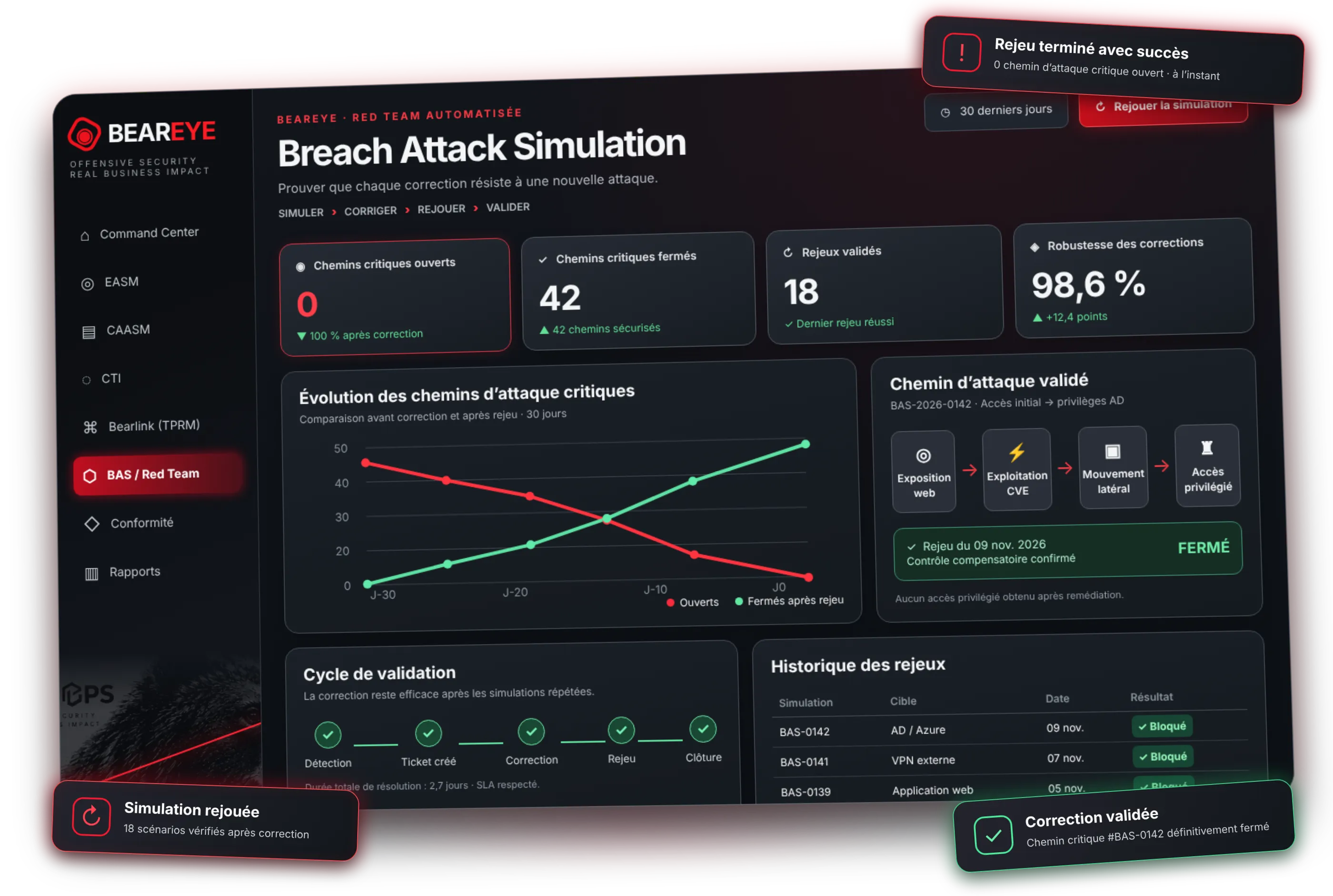
Proving that the fix holds
After each fix, Beareye replays the attack to confirm that the path is indeed closed. The trend in the number of critical paths opened then closed becomes a simple indicator of falling risk, ready to use in management reports.
What share of simulated attacks do your defences stop?
On the first run, 64% of the techniques simulated with Beareye were neither blocked nor detected. After remediation, replaying the same scenarios brought this share down to 7%. It is this gap, measured on the same tests rather than estimated, that proves the remediation holds.
Aggregated, anonymised data from Beareye’s automated Red Team (BAS/CART): 20 organisations over two years. Before-and-after comparison on the same tests and the same scopes.
Sources and references
Sources consulted on . Report an error: contact+site@bearops.fr
Frequently asked questions
What are BAS and CART?
BAS (breach and attack simulation) automatically simulates attacks, based on known techniques such as those listed in the public MITRE ATT&CK framework, to check whether defences hold. CART (continuous automated red teaming) replays this logic continuously. Beareye combines both for permanent offensive validation of your exposure.
Does the automated Red Team replace a human pentest?
No. It maintains validation between two pentests, across the whole scope and continuously. The human pentest keeps its value for in-depth exploration and judgement. The two approaches are complementary, not competing.
Is it risky to run these simulations in production?
Beareye’s automated Red Team takes a non-destructive approach, with a defined scope and safeguards, to prove exploitability without disrupting operations.
How is it different from a simple scanner?
A scanner reports isolated vulnerabilities. The automated Red Team chains them together to reconstruct a complete attack path, pivoting between assets, and confirms real exploitability. It proves what an attacker would do, not just what exists.
See what an attacker would exploit in your environment
A demonstration shows how Beareye’s automated Red Team reconstructs an attack path in a test environment, then replays it after remediation.