Beareye · Module
Cyber Threat Intelligence: turn threat signals into security decisions
By Steven Carrier Updated on
The CTI module of the Beareye Command Center brings together the threat signals that concern you: leaked data, dark web activity, brand impersonation, known attack techniques. It enriches them, puts them in the context of your exposure, and turns them into prioritised decisions. CTI does not produce yet another stream of alerts; it produces meaning.
- Leaks and dark web monitored
- MITRE ATT&CK mapping
- Developed in France
Threat feeds that nobody has time to use
Intelligence sources abound, but a CISO has neither the time nor the team to sort through generic feeds and extract what really concerns them. A useful alert gets lost in the noise. Beareye CTI filters according to your real exposure and ranks what deserves action.
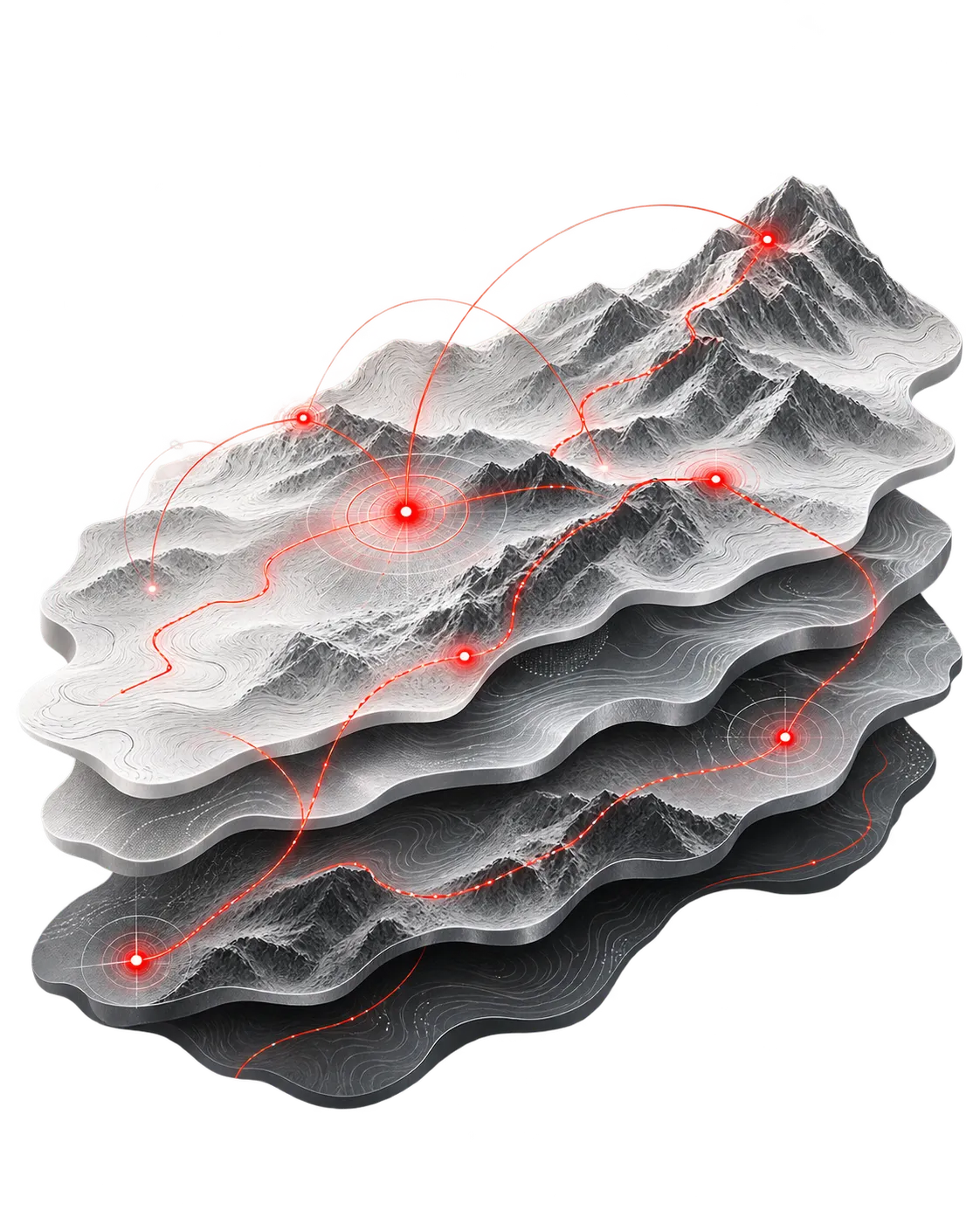
From raw signal to decision
-
Collect
Open sources, dark web , leaks, technical indicators.
-
Enrich
Context, cautious attribution, cross-checking of sources.
-
Correlate
Linking with your attack surface and your assets.
-
Disseminate
Prioritised alerts and reports your teams can act on.
What does Beareye CTI monitor?
Beareye CTI covers OSINT on your organisation and your physical sites, mapping of information leaked on the dark web (credentials, email addresses, documents, bank details), generation of the MITRE ATT&CK matrix and its mapping onto attacker kill chains, and CVE analysis.
-
OSINT on your organisation and sites
What open sources reveal about your organisation, your executives and your physical sites.
-
Dark web and leaks
Credentials, emails, documents and bank details found outside your perimeter.
-
MITRE ATT&CK and kill chains
The tactics and techniques of attackers targeting your sector, linked to their attack scenarios.
-
CVE analysis
Published vulnerabilities, matched against the technologies you actually run.
Placing the threat on recognised frameworks
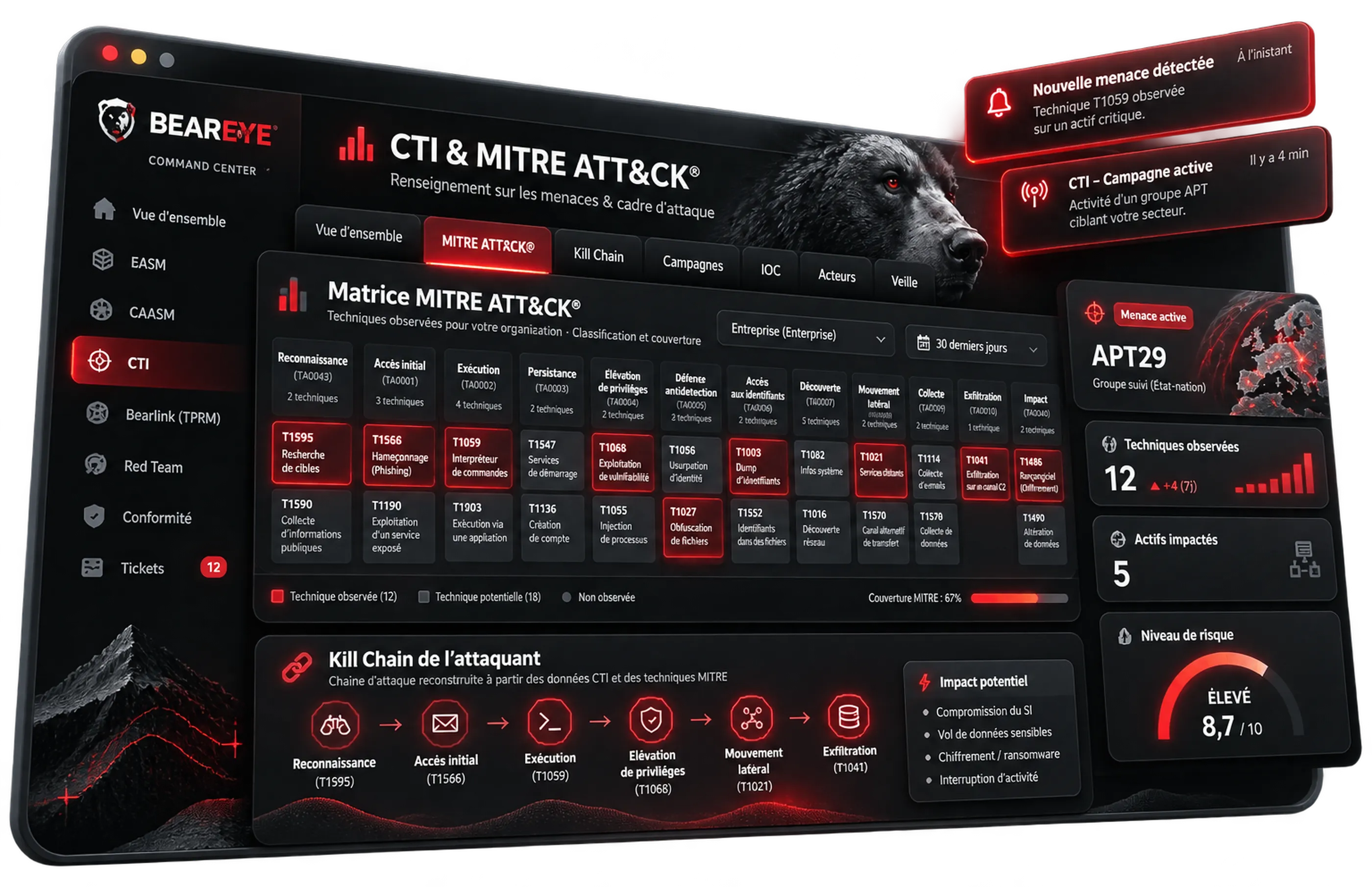
Beareye automatically generates the MITRE ATT&CK matrix from the data collected and links it to the kill chains of advanced attackers. The CISO sees which tactics and techniques really concern them, and can prioritise defences on the most likely scenarios for their sector.
CTI or OSINT: what is the difference?
OSINT collects raw information from open sources about your organisation. CTI is the complete process that enriches this information, adds the dark web and attack techniques, then draws decisions from it. OSINT is a source of CTI, not its equivalent.
| Criterion | OSINT | CTI |
|---|---|---|
| Nature | Collection from open sources | Complete intelligence cycle: collect, enrich, correlate, disseminate |
| Sources | Publicly accessible information about your organisation, your sites and your staff | Open sources, plus the dark web, leaked data, technical indicators and frameworks such as MITRE ATT&CK |
| Question addressed | What is exposed about us? | Which threats target us, how, and what should we do? |
| Outcome | What is exposed about you | Prioritised decisions in the face of the threat |
| In Beareye | Continuous OSINT monitoring | CTI module, which includes OSINT among its sources |
Which attack techniques come up most often?
In the 2025 malware analysed by Picus Security, the three most frequent MITRE ATT&CK techniques are process injection (T1055), command and scripting interpreter (T1059) and credentials from password stores (T1555), found in 23% of samples. A single sample can combine several techniques. This ranking is used to adjust validation scenarios and monitoring priorities.
External benchmark, not BEAROPS data: Picus Security, Red Report 2026, 1,084,718 malware samples from 2025 analysed.
Sources and references
- Picus Security, Red Report 2026: the top ten MITRE ATT&CK techniques
- MITRE ATT&CK, The MITRE Corporation
- National Vulnerability Database (CVE), NIST
Sources consulted on . Report an error: contact+site@bearops.fr
Frequently asked questions
What is Cyber Threat Intelligence?
CTI is intelligence about the threat: the process of collecting, enriching and contextualising attack signals in order to draw security decisions from them. It answers the question: which threats concern me, and what should I do?
What is the difference between CTI and OSINT?
OSINT is the collection of information from open sources. CTI is the complete cycle that uses this collection, adds the dark web and attack techniques, then produces prioritised decisions. OSINT feeds CTI.
Does Beareye CTI monitor the dark web?
Yes. The module maps information leaked on the dark web: credentials, email addresses, documents, bank details. These leaks are correlated with your exposure to distinguish an old, harmless leak from an active risk.
What does the MITRE ATT&CK matrix bring to Beareye?
Beareye automatically generates the MITRE ATT&CK matrix from the data collected and links it to attacker kill chains. You see which techniques really concern you and can prioritise your defences on the most likely scenarios.
See the threat that really concerns you
A demonstration of the CTI module shows the threat signals affecting your organisation, correlated with your real exposure, on your own scope.